Obedience Class List
IPOC Obedience Program
Getting Started
IPOC Obedience Titling Path
Getting Ready
The IPOC Obedience Program
The Puppy and Basic Obedience classes are entry level classes, and they are exempt from prerequisites.
All other Obedience classes that are not entry level classes have the prerequisite of successful completion of the Basic Obedience class at IPOC.
We may be able to accommodate Obedience drop-ins for some classes, but you must obtain permission from the class instructor each time that you drop-in.
Proof of vaccination is required at the start of each Training Session for out Puppy and Basic Obedience Classes.
Every dog must have a properly fitted training collar and a leash. Most classes recommend a 4 ft leash, but there are exceptions, e.g. Scent Work classes prescribe a 10 ft leash.
View our class schedule for current classes, times, and fees.
Basic Obedience Test
Basic Obedience skills are required for you to register your dog in IPOC's more advanced classes. To pass Basic Obedience, your dog must:
-
Wait at the gate to enter the ring
-
Sit stay for 30 seconds
-
Down stay for 30 seconds
-
Stand stay for 5 seconds
-
Go to Place (one leash length away), and sit or lie down
-
Accept a friendly stranger
-
Sit for exam
-
Loose leash walking
-
Loose leash walking, Normal speed
-
Right turn
-
Loose leash walking, Slow speed
-
About turn
-
Loose leash walking, Fast speed
-
Left turn
-
Halt
-
-
Recall
Classes:
Wednesday
7:00pm - 8:00pm
Puppy Class
The Puppy class is for pups who are from 8 weeks to 5 months old at the time of enrollment. Handlers should arrive equipped with a leash, a collar, a tug toy, and plenty of small, easily chewable treats.
The class includes the following as well as much more:
-
Introduction to different walking surfaces
-
Reliable recalls
-
Developing a relationship with your puppy
-
Tricks
-
Traditional obedience behaviors such as sit, down, stand, and walking on a loose leash.

Classes:
Tuesday
6:10pm-7:10pm
Wednesday
7:00pm - 8:00pm
Basic Obedience
The Basic Obedience class is for all dogs who are 6 months old or older at the time of enrollment. You will learn to teach your dog to walk on a loose leash, sit, lie down, stand, come when called, and stay in one place.
Basic Obedience's goal is to prepare dogs to pass the AKC's CGC (Canine Good Citizen) test that is administered by an AKC CGC® Approved Evaluator and that requires your dog to:
-
Accept a friendly stranger
-
Sit politely for petting
-
Welcome grooming and examinations
-
Walk with a loose leash
-
Walk through a crowd
-
Sit and down on command and Staying in place
-
Come when called
-
Behave politely around other dogs
-
Display confidence in the face of distracting situations
-
Endure 3 minutes of supervised separation

Classes:
Tuesday
6:00pm - 7:00pm
Advanced Basic
The prerequisite is passing Basic Obedience.
Advanced Basic will continue to build on the skills learned in Basic Obedience.
You will be taught:
-
Stationary Attention
-
Heel position
-
Heeling With Attention
-
Sphinx Down
-
Perch Work
-
Sit Stay
-
Down Stay
-
Restrained Recall
-
Sit for exam
-
Stand for Exam
-
Pivots
-
Side steps While Heeling
-
Left Turn
-
Right Turn

Classes:
Saturday*
10:00am - 12:00pm
* Urban Dog is held during cooler months
Oct -April
Check calendar for dates
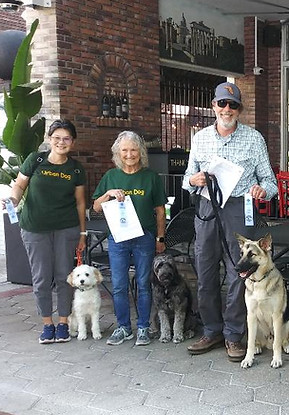
Urban Dog
The prerequisites are
-
pass Basic Obedience,
-
have an AKC CGC title.
In addition, handlers and dogs must be able to rigorously walk for 60 to 90 minutes over varied surfaces.
The goal of the Urban Dog class is to teach you to train your dog in the foundation skills needed to maneuver safely and successfully in urban locations while gaining control and confidence.
This class also prepares you and your dog to master the AKC Urban Canine Good Citizen test; no other class is needed.
Each week the class will meet at a different location around Lakeland to work on skills specific for that location. Some of the skills introduced and reinforced are:
-
walking on a loose leash under control, through a crowd, on a busy sidewalk, or in a dog friendly public building,
-
ignoring dropped food and containers,
-
sitting and lying down on command,
-
standing on command,
-
staying in place,
-
coming when called,
-
behaving politely around other dogs,
-
staying in a long down while you are in a public building or eating at a restaurant,
-
crossing streets, skywalks, and parking lots,
-
behaving politely at dog friendly restaurants,
-
navigating complex stairs and elevators,
-
becoming accustomed to noises (vehicles, horns, sirens, construction), moving objects (bicycles, joggers, carts), and other distractions (different surfaces, people wearing hats/coats, or carrying/using umbrellas),
-
safely entering and exiting buildings and cars, and
-
accepting a friendly stranger.
Necessary items for the class:
-
dog bowl and water
-
6 ft leash
-
20 ft line or leash
-
closed toe shoes
-
high value treats/toy
-
waste clean-up bags